


Cargo Boom
Skyloft Yazılım Bilişim ve Anonim Şirketi
I went into Cargo Boom expecting a quick arcade game, and that is exactly where it feels most comfortable: short decisions, visible progress, and a delivery operation that gradually becomes more capable. You scan boxes, bring workers into the operation, improve hubs, and try to turn a small setup into a wider delivery network. The idea is easy to understand, but the appeal comes from deciding what deserves attention first.
As a free arcade game from Skyloft Yazılım Bilişim ve Anonim Şirketi, it is aimed at people who enjoy management-flavored progress without committing to a long strategy session. I found the premise approachable for a first-time player because the early goals are easy to read. You are not asked to understand a complicated economy before doing anything useful. Instead, the game gives you a simple loop: handle cargo, improve the operation, and use the improvement to handle more cargo.
The important expectation is that this is not a realistic logistics simulator. I would not install it hoping to plan actual shipping routes, calculate warehouse capacity, or study a detailed transport model. Its delivery theme is a framework for arcade progression. That makes it a better fit for casual play, especially when you want something with more direction than an endless reflex game but less mental weight than a full business simulation.
Starting with the first shipment
The first minutes are best treated as a guided tour of the game’s rhythm rather than a test of efficiency. I recommend taking a moment to see what the box-scanning action does before spending attention on upgrades or workers. The scan is the basic interaction, so becoming comfortable with it gives the rest of the system a clear starting point. Once that action feels familiar, the other parts of the operation make more sense.
My advice for a new player is to avoid trying to optimize the entire delivery empire immediately. Early progress is more useful when you focus on one complete cycle: scan cargo, let the operation process it, collect the resulting progress, and then inspect what improvement is available. This creates a reliable routine and prevents the interface from feeling like a collection of unrelated buttons.
Related News






The game’s Teen content rating is worth keeping in mind for families deciding whether it suits a younger player. It is also available free of charge, while optional purchases are listed from $2.99 to $5.99 per item. I would begin without buying anything. That gives you enough time to decide whether the scanning-and-upgrading loop is genuinely enjoyable for you before spending money on acceleration or convenience.
One useful habit is to treat every early improvement as an experiment. If you can choose between making the current cargo process feel smoother and expanding the operation, notice which change actually improves your next few minutes. This is more helpful than automatically selecting the most impressive-looking upgrade. In a game built around a growing network, the best choice is not always the one that sounds largest; it is the one that removes the bottleneck you are currently noticing.
How the first meaningful success feels
Your first satisfying milestone is not simply scanning a box. It is completing a small chain in which the scan contributes to a stronger operation. When I reached that point, the game became easier to read: cargo was no longer an isolated tap, and upgrades were no longer abstract rewards. They were part of a loop that connected the immediate action with the longer-term goal of building a larger delivery business.
Gallery
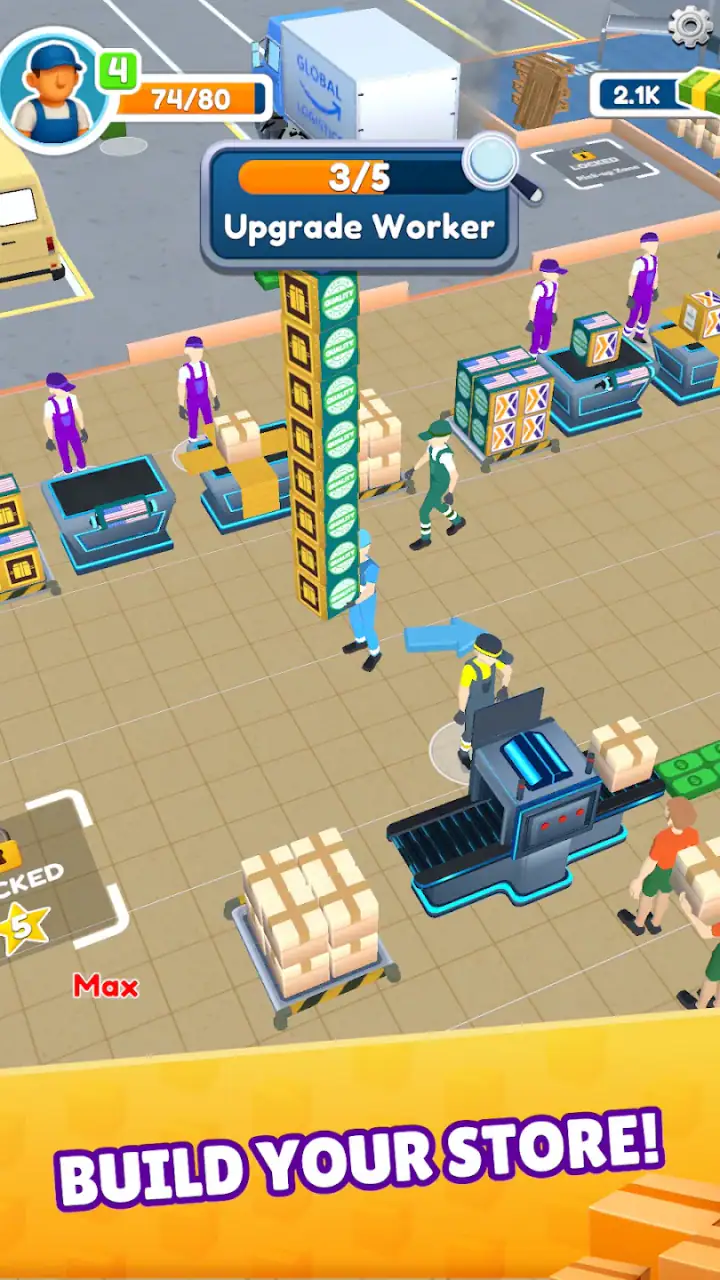
For a first session, I would use this order of attention:
Learn the scanning action without rushing through the surrounding screens.
Watch how workers and hubs affect the next stage of progress.
Choose one improvement and observe its practical effect before making another decision.
Return to cargo handling and see whether the operation now feels faster, broader, or easier to manage.
This approach gives you a meaningful success without requiring perfect choices. That matters because the game is more enjoyable when you understand why progress is happening. If you simply tap through every available option, you may advance, but you lose the small management decisions that give the arcade structure its personality.
A realistic everyday use case is a short break between tasks. I can imagine opening it while waiting for an appointment, handling a few boxes, checking whether a hub needs attention, and closing the game after a clear improvement. It also works for a longer relaxed session when you want to see how far the operation can grow. The difference is that the short-session player should focus on one complete cargo cycle, while the longer-session player can compare several upgrade priorities.
Workers, hubs, and the decisions behind progress
Hiring workers sounds straightforward, but I would not view workers as automatic progress by themselves. Their value depends on how they fit into the part of the operation that is slowing you down. If cargo handling is the part that feels repetitive, improving the workforce may make the loop more comfortable. If the larger problem is that your network lacks reach or capacity, a hub improvement may be more meaningful.
This is one of the game’s less obvious trade-offs: the most visible action is not necessarily the most important decision. Scanning boxes gives immediate feedback, while workers and hubs shape what happens after that action. I found it useful to separate instant satisfaction from structural progress. Scan when you want to stay active, but inspect the operation when you want to make a decision that will affect several future cycles.
Hubs are especially important to think about as connection points rather than decorative milestones. When the operation begins to feel scattered, ask whether the problem is the amount of cargo you are handling or the way your delivery network is developing. That question helps prevent a common mistake: spending every resource on the action you see most often while ignoring the part that determines how the broader empire grows.
Another practical tip is to pause after each meaningful improvement instead of immediately buying the next option. Give the new worker or hub change a chance to show its effect. This makes it easier to tell whether a purchase solved a real problem or merely looked attractive in the menu. It also reduces the temptation to spend resources just because an upgrade is available.
Where first-time players may get confused
The main source of confusion is the relationship between the three central ideas: scanning, workers, and hubs. Each sounds useful on its own, but the game becomes clearer when you see them as layers of the same delivery process. Scanning is the hands-on activity, workers support the operation, and hubs represent the wider structure you are building. Thinking in those layers is more useful than treating them as separate mini-games.
Players may also wonder whether they should keep tapping constantly or wait for the operation to develop. My answer is to alternate. Stay active when scanning is giving you a clear task, then step back and inspect your workers and hubs when the next decision matters more than another immediate action. That rhythm makes the game feel less frantic and helps you notice where progress is actually coming from.
Another point worth clarifying is the meaning of “global” in the game’s premise. I read it as a long-term ambition for the delivery network, not as a promise that the game behaves like a detailed worldwide shipping tool. The fun is in seeing the operation expand conceptually and mechanically, not in reproducing real customs rules, fuel costs, or international delivery schedules. If you want authentic logistics complexity, this will feel intentionally light.
The current version is 0.7.05, which also sets a sensible expectation: I would approach it as a developing arcade experience rather than a finished business simulator with every possible layer. That does not prevent it from being enjoyable, but it does make patience useful. If you prefer games whose systems are already extremely deep and settled, a more established management title may suit you better.
How to spend attention without spending money
Because the game is free with optional purchases, the first question for many players is whether the basic loop is worth using without paying. In my view, the right test is simple: play until you have experienced the relationship between cargo, workers, and hubs, then decide whether the pace feels satisfying on its own. Do not judge the game only by how quickly the operation grows during the first few minutes.
The listed purchase range makes it especially important to identify what kind of player you are. If you enjoy gradual progress and small operational choices, paying to move faster may remove part of the pleasure. If you dislike waiting or prefer immediate expansion, an optional purchase might feel more attractive, but I would still avoid buying one before understanding the normal progression. A purchase cannot fix a loop that you do not enjoy.
My preferred free-to-play approach is to set a small goal for each session: complete a cargo cycle, improve one weak point, and stop once the operation feels more capable. This keeps the game from turning into a repetitive race for the next purchase. It also makes progress easier to appreciate because each session has a clear purpose rather than becoming an endless sequence of identical taps.
There is a second trade-off here. The arcade format makes the game accessible, but it can also feel shallow to players who want detailed planning. The more you enjoy spreadsheets, route optimization, and complex resource chains, the more likely you are to outgrow this experience. On the other hand, if complicated simulations usually make you quit before you understand them, Cargo Boom’s lighter approach is a genuine advantage.
Who will enjoy it and who should skip it
I would recommend it to someone who likes watching a small operation become more capable, especially when the interaction remains simple enough to play casually. It is a good choice for players who want a delivery theme without the pressure of a competitive match or the precision demands of a reflex-heavy arcade game. The game also suits people who enjoy making frequent, understandable choices rather than memorizing a large rulebook.
I would be more cautious about recommending it to anyone seeking a realistic logistics simulator. The cargo theme may suggest detailed planning, but the actual appeal is the arcade loop of scanning, staffing, and upgrading. Players who need a strong narrative, deep character development, or complex strategy may find the focus too narrow. Likewise, anyone who dislikes free-to-play progression should try the no-purchase experience first and decide based on how comfortable the pace feels.
The rating of 4.5 from around 1.3 thousand ratings suggests that the concept is connecting with a meaningful audience, while the game has passed 100 thousand installs. I see those figures as useful context rather than a substitute for personal taste. They indicate that the basic idea has appeal, but they do not change the central question: do you enjoy turning repeated cargo handling into a growing operation?
Device compatibility is broad enough for older Android hardware, since the game requires Android 7.0 or later. That makes it easier to consider on a device that is not running the newest software. Still, I would keep expectations realistic about the experience on any phone: the game’s strength is its clear progression loop, not the promise of a console-scale simulation.
My practical routine after the first session
After learning the basics, I would use a three-part routine. First, scan enough boxes to understand the current pace. Second, look for the worker or hub that addresses the most noticeable limitation. Third, return to the operation and check whether the choice changed the way the game feels. This routine turns vague upgrading into a repeatable decision process.
When progress slows, do not assume that the answer is always more scanning. Ask whether you are missing a staffing decision or delaying a hub improvement. That small diagnostic step is one of the most useful habits I found because it keeps the game from becoming a single-action loop. It also helps you recognize when the current goal has shifted from handling cargo to expanding the structure around it.
I would also avoid making several major decisions at once. If you hire workers and upgrade hubs together, you may advance more quickly, but you will not know which choice made the difference. Testing one change at a time is slower in the moment and more informative over a full session. For a casual arcade game, that kind of observation is an enjoyable form of strategy rather than unnecessary homework.
Finally, use the game’s short-session nature to your advantage. You do not need to treat every launch as a commitment to build the entire empire. A small improvement is enough. If you return later, you already have a clear starting point: inspect the cargo flow, identify the weak link, and make the next sensible improvement.
Overall, I found Cargo Boom most appealing when I treated it as a friendly arcade management game rather than a serious shipping simulator. Its path from the first scanned box to a broader delivery operation is easy to follow, and the combination of workers and hubs gives the repeated action some direction. The friction comes from the lighter depth and the presence of optional purchases, so it is not ideal for every player.
For a first-time user, my recommendation is reassuringly simple: start free, learn one complete cargo cycle, make one deliberate improvement, and then decide whether the growing operation keeps your attention. If that modest loop feels rewarding, Cargo Boom can become a pleasant pick-up-and-play title. If you need detailed logistics, a fixed-price experience, or a much deeper strategy layer, I would choose a different game in the category instead.
FAQs for Cargo Boom
What is Cargo Boom and how does the game work?
Cargo Boom is a casual cargo-management game focused on organizing, transporting, and delivering goods. Players generally need to plan routes, handle different types of cargo, complete delivery objectives, and improve their operation over time. The gameplay is easy to understand, but later stages may require better timing, resource management, and strategic decisions to complete orders efficiently.
Is Cargo Boom free to download and play?
Cargo Boom can usually be downloaded without an upfront payment, although the exact availability and pricing may depend on whether you use Android or iOS. Like many free mobile games, it may include optional in-app purchases for upgrades, currency, boosters, or other conveniences. Check the store listing and purchase settings before downloading, especially if children use the device.
Does Cargo Boom require an internet connection?
The basic gameplay experience may work without a constant internet connection, but some features can depend on online access. Advertising, cloud saves, account synchronization, updates, leaderboards, and in-app purchases may require an active connection. If offline play is important to you, test the game in airplane mode and remember that progress may not synchronize until you reconnect.
Is Cargo Boom suitable for children and casual players?
Cargo Boom is generally designed to be approachable, with simple controls and objectives that casual players can learn quickly. However, the appropriate age rating, advertisements, chat features, and purchase options can vary by platform and version. Parents should review the official store rating, privacy information, and in-app purchase settings before allowing younger players to use the application.
What devices are compatible with Cargo Boom?
Compatibility depends on the specific version of Cargo Boom and the operating system installed on your device. Before downloading, check the official Google Play or App Store page for the minimum Android or iOS version, required storage, and supported devices. Keeping your phone updated and freeing sufficient space can also help prevent crashes, installation problems, or slow performance.
Pros
- Simple controls make it easy to start playing quickly.
- Short levels are convenient for brief gaming sessions.
- Cargo-themed challenges offer a different casual gaming concept.
- Progression encourages players to keep improving their delivery skills.
- The game can be enjoyable for players who prefer relaxed gameplay.
Cons
- Gameplay may feel repetitive after extended play sessions.
- Some levels can become frustrating when precision is required.
- The game may offer limited depth for experienced players.
- Progress can feel slow if later challenges require repeated attempts.
- Performance may vary on older Android or iOS devices.


